An official website of the State of Georgia.

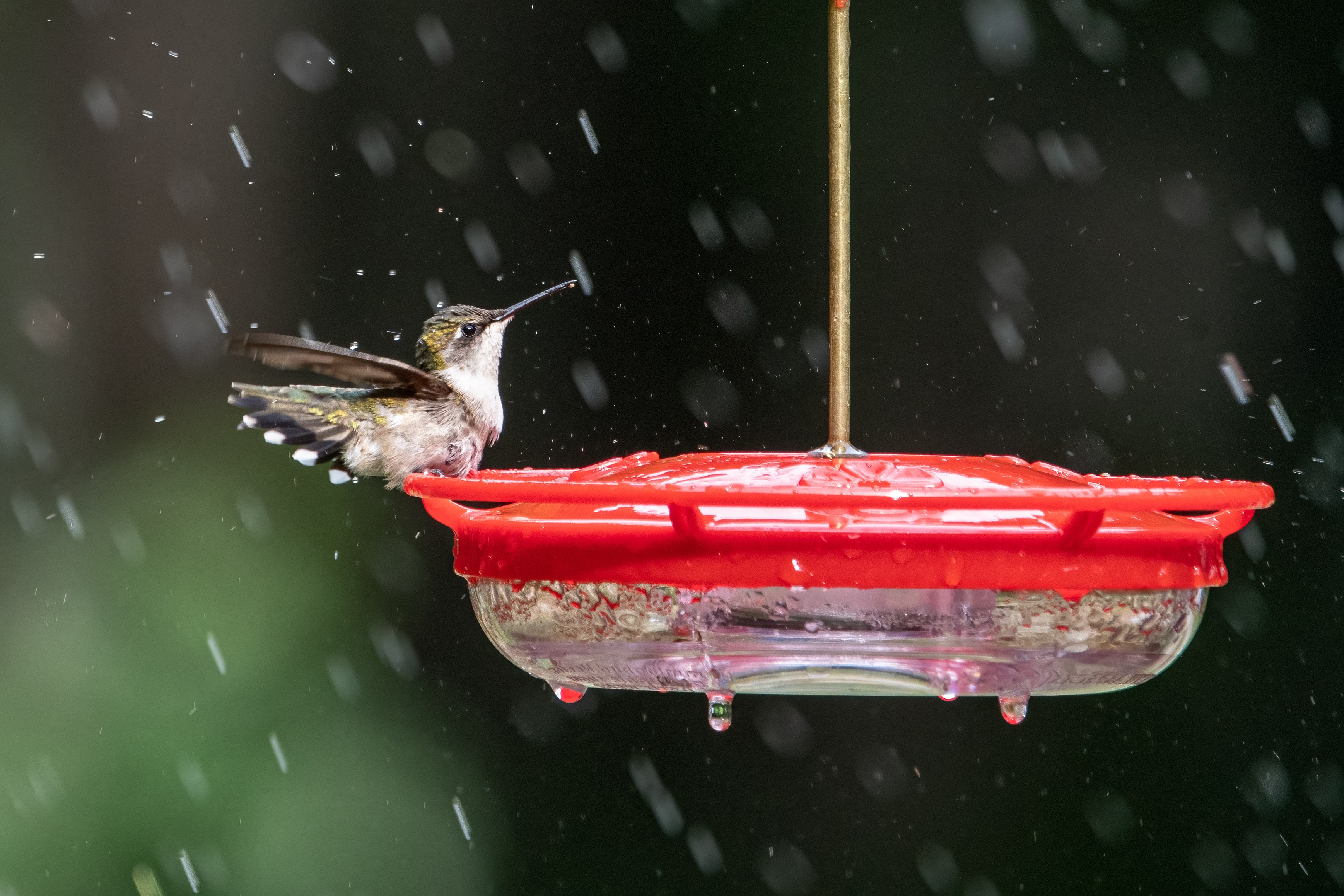
A ruby-throated hummingbird feeding during rain
By Terry W. Johnson
To hummingbird fanciers, these tiny flying jewels are an important part of their lives from early spring, through summer and into early fall. While hummingbirds are living in our yards, we do all we can to provide them with an abundance of nectar served in feeders and produced by a variety of native and ornamental plants. These plants also host small insects and spiders that supply the birds with much-needed protein.
In exchange, the birds provide us with hours of enjoyment.
But all too soon, ruby-throated hummingbirds embark on their fall migration. Many hummer enthusiasts worry that the small birds will be unable to survive the perils they face in route to their winter homes hundreds of miles away. Just last month, their concern for the hummers that had just left on migration peaked when a strong hurricane named Isaias churned across the Gulf before going ashore near Destin, Fla.
Fortunately, hummingbirds have a number of ways to overcome the challenges spawned by hurricanes and other powerful weather events. These tools are so effective that, in spite of the fact that the paths many of these storms take overlap with the ruby-throated hummingbirds’ migration path spanning the Gulf and ending in wintering grounds that extend from southern Mexico south to Central America, rubythroat numbers remain high.
If migrating hummingbirds encounter headwinds of 25 mph or more, they cannot fly forward and will eventually fall into the warm waters below. In such situations, the only refuge hummingbirds have are oil rigs. Here, some birds can ride out the storm and refuel with sugar water offered in feeders put up by workers.
But hummers have other factors besides chance in their favor.
The birds have something called a Vitale organ. This special organ in their middle ear allows hummingbirds to detect changes in barometric pressure. A significant drop in pressure enables the birds to detect approaching storms, an advance warning that lead them to delay migration or alter their flight path. For example, when faced with a storm coming in from the Gulf, the migrants can fly overland west along the Gulf Coast toward Texas and Mexico.
When the weather deteriorates and hummers are still inland, the birds seek shelter in dense cover. They also hunker down on the downwind sides of trees.
It also helps that migrating hummingbirds carry large amounts of fuel stored as fat. This is demonstrated by the fact that the birds will double their weight before they begin fall migration. Before hummingbirds start, they weigh about as much as a penny. In comparison, when they leave our yards and head south, they weigh as much as a nickel.
During migration, if a storm persists, the birds will burn a significant amount of their available fuel. After the storm passes, they may not have enough to finish their flight across the Gulf. To prevent this from happening, hummingbirds go into torpor. When they are in this state, their body temperature as well as their metabolic, heart and breathing rates drop significantly, allowing them to burn far less fuel than they normally would.
Amazingly, when the eye of a hurricane passes and the wind speeds plummet, hummingbirds will take advantage of the brief lull and resume feeding.
Once all of the storm moves away, the birds exhibit voracious appetites. The problem is that hurricane winds and heavy rainfall typically strip the blossoms from nectar plants. When this happens, feeders are their only source of food for hummingbirds.
I have a vivid memory of a photograph of hummingbirds swarming around a feeder hanging in a barren backyard on the Texas coast after a hurricane swept through. The image shows hummingbirds swarming around a single feeder in a yard that is devoid of vegetation.
Several years ago after another major hurricane hit the Texas coast, I talked to the owner of a bird supply store that was inland in an area spared the devastation suffered by coastal communities. The storm had passed through during the peak of the fall hummingbird migration. The man said that once he learned there was an acute shortage of natural nectar and feeders along the coast, he sent folks living in the hard-hit areas a truckload of hummingbird feeding supplies.
Overall, the thing to remember is that for thousands of years hummingbirds have coexisted with these deadly storms. Since fall migration takes place over several weeks, each year most hummingbirds are never threatened by a hurricane and successfully complete their perilous migration. With that hope in mind, and an understanding of how these birds can adapt and persevere even during this massive weather events, I can assure you that hummingbirds will be feeding at flowers and feeders in your backyard next year.
Terry W. Johnson is a retired Georgia DNR program manager and wildlife biologists. Check out past columns, his Backyard Wildlife Connection blog and his book “A Journey of Discovery: Monroe County Outdoors.” Permission is required to reprint a column.