An official website of the State of Georgia.
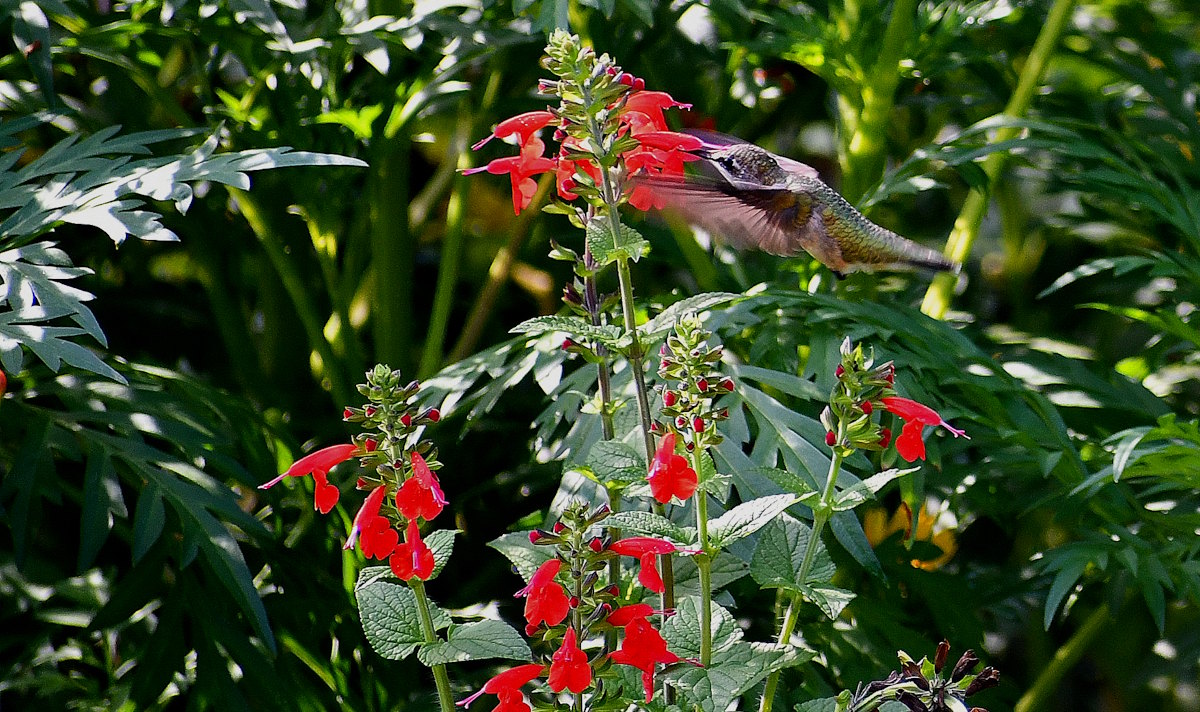
Ruby-throated hummer feeding at scarlet sage (Terry W. Johnson)
By Terry W. Johnson
For the past several years, the native version of the plant called red salvia has become one of my favorite garden flowers.
Now, there are a number of plants sold in nurseries and big box stores called red salvia. But these plants should never be confused with the true red salvia (Salvia coccinea), also commonly known as scarlet sage.
I must credit my wife Donna for bringing red salvia to our yard. Since she is a fan of both butterflies and hummingbirds, she is constantly searching for plants that attract these colorful backyard residents. A few years ago, her research led her to red salvia. Liking what she read about the plant, she bought some red salvia seeds and planted them near our deck where we could keep a close eye on them and any wildlife the plants attracted.
To say the least, what we learned about the plant that summer sold us on its virtues.
One thing we like about Salvia coccinea is that it is native to Georgia. In the wild, scarlet sage ranges across south Georgia. However, it will grow anywhere in the state (plant zones 7 and 8). As wildlife gardeners know, many ornamental and native plants do not always do well in our gardens. But rarely is this a problem: Red salvia will grow in a variety of soil types, although it does the best in well-drained soils. Nor does it require a lot of water. In fact, once established, the plant is drought tolerant. As you might imagine, though, plants grown in full sun will display more blooms than those living in shadier spots.
We have also learned that, in our neck of the woods, once it becomes established red salvia will readily reseed and come back year after year. In warmer climes it is a perennial. With time, it can spread, too. However, if it ever invades areas where you do not want it to grow, all you have to do is to pull up the unwanted plants.
We have also learned the plants are easily transplanted. You can move them about your gardens or share them with others. And if you have a problem with deer nibbling the plants in your yard, you will be happy to learn that white-tailed deer rarely snack on these pungent leaves.
Scarlet sage's stunning red, tubular flowers are laden with nectar. Consequently, they attract a number of different wild pollinators, including butterflies and hummingbirds.
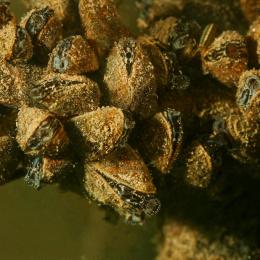
If that is not enough, birds will eat the red salvia’s tiny seeds. After the flowers complete blooming, they are replaced by brown seed heads, which attract wildlife. For example, house and American goldfinches relish eating the small seeds, plucked from the dried seed heads. (An adult male American goldfinch dropping in to dine on the seeds can almost take your breath away!)
Butterflies, bees and other pollinators regularly visit the plant’s showy blossoms. The butterfly we see most often visiting red salvia is the cloudless sulphur. This large, yellow butterfly dwarfs the long, slender, red blossoms when it comes to sample the nectar.
Ruby-throated hummingbirds also regularly feed at the red blossoms. Knowing this, on a number of occasions, I have mounted my camera on a tripod, plopped down in a folding chair near a bed of scarlet sage and waited for the arrival of a hungry hummingbird. These photo sessions have enabled me to learn a lot about the feeding habits of these amazing birds.
One of the first things I noticed is that, unlike butterflies, while feeding they do not linger very long on one flower. Instead, they zip up to a tubular-shaped blossom, thrust their long bill into the flower, feed for a couple of seconds, then move to a nearby blossom. After feeding for a short while, the birds abruptly zip away.
If you watch hummingbirds feeding at red salvia, you will eventually see birds touch blooms that suddenly fall to the ground. When this happens, the flower does not fall because it was snatched from the plant: It is simply an old blossom that would have soon fallen anyway. Instead of being dislodged by the next puff of a gentle wind, it became detached because of the feathery touch of a feeding hummingbird.
Another thing I have noticed is that while butterflies seem to feed during the hottest times of the day; rubythroats more often appear early and late in the day. This could be due to fact that the nectar flow of some flowers slows as temperatures rise.
Salvia coccinea can be easily grown from seed. Plants can also sometimes be found in some nurseries.
If you are looking for an easy-to-care for and attractive addition to your garden that is also a favorite of hummingbirds, butterflies and other pollinators, this may be just the plant for you. Believe me, if you adorn your gardens with red salvia, you will truly enjoy watching the aerial displays performed by hummingbirds drawn to the plant’s breathtakingly beautiful flowers. In addition, you will soon understand why many consider scarlet sage to be the quintessential hummingbird plant. I know my wife and I do.
Terry W. Johnson is a retired Georgia DNR program manager and executive director of The Environmental Resources Network, or TERN, the friends group of DNR’s Wildlife Conservation Section. Check out past columns, his Backyard Wildlife Connection blog and his book “A Journey of Discovery: Monroe County Outdoors.” Permission is required to reprint a column.