An official website of the State of Georgia.






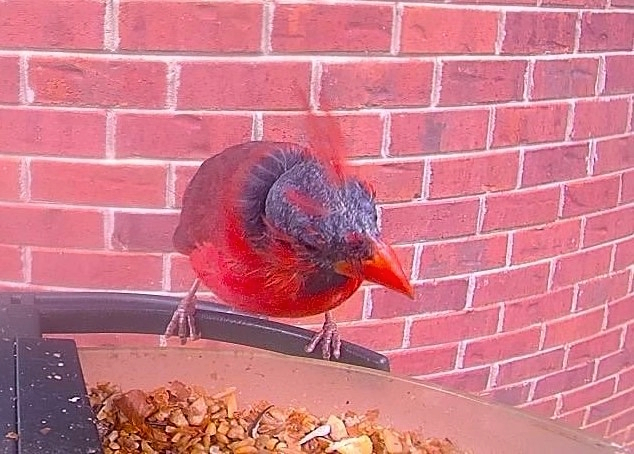
Bald northern cardinal at a bird feeder (Angela Dupree/Special to DNR)
By Terry W. Johnson
Each year some very unusual northern cardinals are seen at feeders throughout the state. At a distance, they look like any other cardinal. If, however, you catch a closer look, you realize these birds are quite different: They are bald.
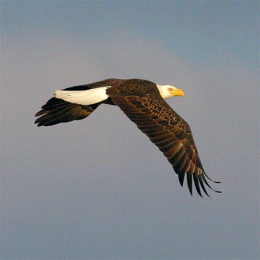
As you know, bald eagles are called bald because at a distance the white feathers that cloak the birds’ heads give the illusion that their heads lack any feathers. Such is not the case with bald cardinals. These birds lack most or all of their head feathers. As a result, their heads are as bare as the head of a turkey vulture.
If you see a bald cardinal, you will probably be surprised that the skin on the bird’s head is black. Another thing that catches your eye is that loss of feathers reveals its ear holes (birds do not have external ears like us) just below its eyes.
Fortunately, the baldness lasts for only a few weeks and does not appear to affect the health of these cardinals.
The baldness typically takes place during spring or summer. If a male cardinal loses it his head feathers in the spring, his chances of being selected by female as her mate drop significantly. The reason for this is female cardinals choose mates based on a male’s plumage and song. Needless to say, a bald cardinal is not as striking as one in full plumage.
While cardinals are more apt to display this condition, it also affects other birds such as blue jays, common grackles and red-winged blackbirds.
Birds typically molt their feathers a few at a time. These molts typically occur after the breeding season ends in late summer. If that was not the case, birds would be flightless until their molted flight feathers are replaced.
One notable exception to this rule is the American goldfinch. This striking bird molts before the onset of its breeding season. Perhaps this is because American goldfinches nest long after most backyard birds have finished their nesting activities earlier in the summer.
Interestingly, most ducks and geese lose all of their flight feathers at the same time. This leaves them unable to fly for about a month. It also makes them extremely vulnerable to predators, which is why these birds spend the time they are flightless in secluded areas.
A number of factors might contribute to cardinal baldness. For example, it has been suggested that parasites such as mites or lice are responsible. Proponents of this theory note that it is basically impossible for a bird to pluck feather mites and lice off its own head, while these critters are more easily controlled in spots the birds they can reach with their feet or bill.
For some unknown reason, many bald cardinals are juveniles that are developing their first adult plumage. Biologists are trying to determine whether the condition might be related to nutrition or environmental factors such as temperature.
If you see a bald cardinal is your backyard, the only way you can help the bird is keep your feeders full of sunflower, white millet and safflower seeds. Also, you might be able to hinder the spread of parasites to healthy birds by keeping your birdbaths and feedrs as clean as possible.
Cardinal baldness is a stark reminder that that while our understanding of the natural world is expanding, we have so much more to learn.
Terry W. Johnson is a retired Georgia DNR program manager and a wildlife biologist. Check out past columns, his Backyard Wildlife Connection blog and his book “A Journey of Discovery: Monroe County Outdoors.” Permission is required to reprint a column.