An official website of the State of Georgia.


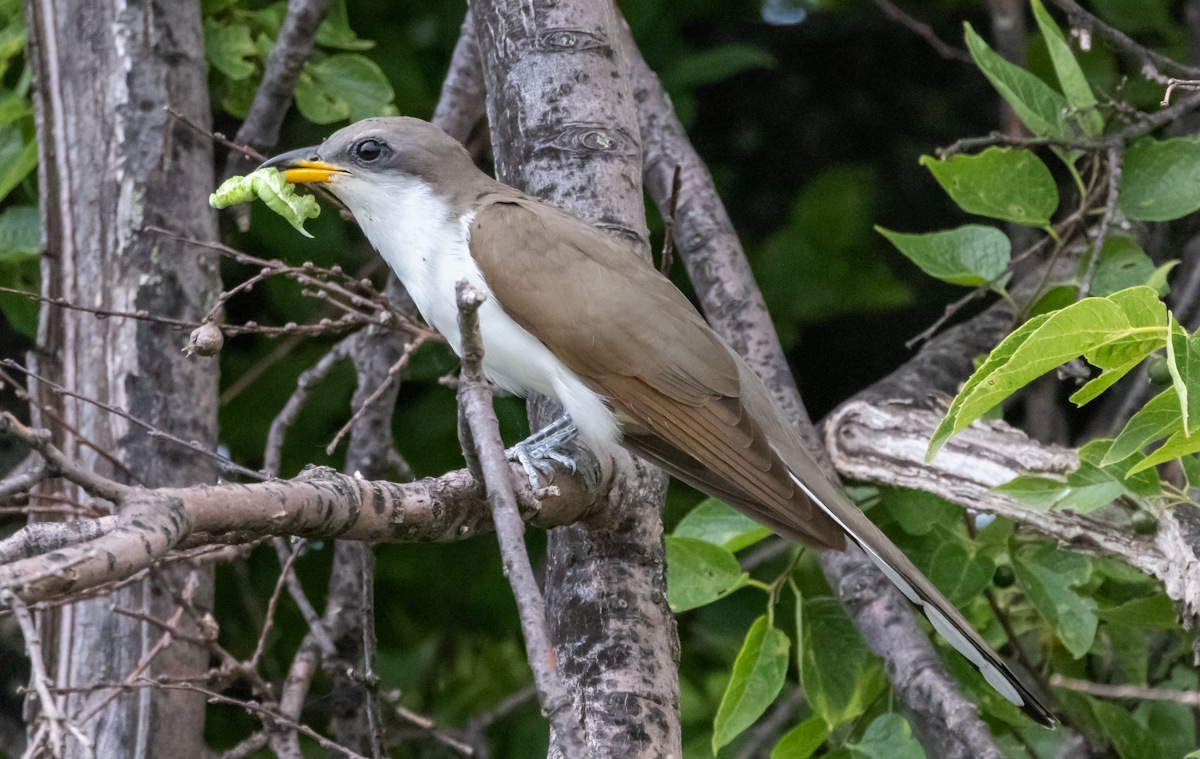
Yellow-billed cuckoo
By Terry W. Johnson
One of Georgia’s most secretive birds is the yellow-billed cuckoo. In spite of the fact it lives here from April into early November, Georgians can go an entire year or more without seeing one. In fact, the bird is far more often heard than seen. Although its unusual song is one of the sounds of summer, in this part of the world, most folks are unable to identify it.
The famous early American painter John James Audubon noted in his journals that in the 1800s farmers called the bird the rain crow. Why? Farmers noted that when yellow-billed cuckoos called on hot, humid, sultry summer afternoons, more often than not thundershowers were approaching. To this day, yellow-billed cuckoos are commonly known as rain crows.
You have probably heard this bird’s call. The sound, which the cuckoos make both day and night, sounds something like kuk-kuk-kuk. If you find this description confusing, listen to the call on the free Merlin bird identification app or online, including at BirdNote.
If you happen to spot a yellow-billed cuckoo, you will see that it is much larger than most of the birds we see in our yards. The bird is 11 to 13 inches long. Its bill is slightly curved and features a yellow lower mandible. The bird’s head, back and wings are brown, and rufous feathers are present on its wings. The cuckoo’s belly is white. The underside of its tail is black and features six large white spots.
History tells us the yellow-billed cuckoo is featured in the second plate created (1821-1822) by Audubon for his famous book “The Birds of America.” He also wrote about the cuckoo in his series “Ornithological Biography.”
Others have also taken note of yellow-billed cuckoos. Thomas Jefferson listed the bird in Virginia’s first natural history checklist. Henry David Thoreau later wrote about them in his classic book “Walden.”
This cuckoo species prefers to live high in the canopies of open hardwood forests that feature thick understories. They can also be found in yards featuring mature hardwood trees, hunting for food such as lizards, cicadas, katydids and moth and butterfly caterpillars.
The birds may be best known for feeding on tent caterpillars, often called tent-making caterpillars. The yellow-billed cuckoo is one of the only birds that eats caterpillars covered with spines. After they tear into a tent caterpillar nest, a single cuckoo can eat more than 100 of the caterpillars at a time, scarfing down dozens in minutes. Per year, each can consume thousands.
One reason why the yellow-billed cuckoo can accomplish this remarkable feat is because throughout the spring and summer it periodically sheds the lining of its stomach. This allows the bird to expel the thousands of caterpillar spines that collect there.
Due to the bird’s propensity for caterpillars, the famous ornithologist and “Georgia Birds” author Thomas Burleigh wrote, “No bird is more valuable to farmers, horticulturists and foresters than the cuckoo.”
Years ago, however, not everyone admired cuckoos. The reason for this is that cuckoos also eat catalpa worms (caterpillars that dine on the leaves of the catalpa tree). It seems catalpa worms are a favorite bait of anglers fishing for bluegills, redbreast and other fish. Consequently, the birds were shot because some anglers believed they ate too much of their fish bait. It’s worth noting that yellow-billed cuckoos are protected by federal and state law, and cannot be shot, caught or possessed.
Even beyond their diet, the yellow-billed cuckoo nesting is truly fascinating. Their platform nests are typically built 4 to 12 feet above the ground. The birds often nest in grape and other vines. Both males and females take part in building the nest. But the nests are flimsy, made of sticks and often so sparse the bird’s eggs can be seen from below.
The females lay an average of two to three eggs, each usually up to five days apart. Females and males incubate the eggs, with females doing the work by day, and males taking the night shift. When the male returns to the nest, it often brings an additional stick, which the female usually adds to the structure.
Amazingly, it takes only 17 days pass from the time an egg is laid to when a fledgling is ready to fly away. In comparison, the nesting process lasts 20-26 days for cardinals and up to 27 days for mockingbirds.
Yellow-billed cuckoos occasionally lay their eggs in the nests of other birds, including at least 11 other different species, from American robins and gray catbirds to wood thrushes and chipping sparrows.
When a nest is threatened, cuckoos will sometimes perform a “distracting display.” When this happens, one bird will remain on the nest while its mate moves to a spot where it can be easily seen by the potential predator, then open its wings and hop up and down. The birds use another variation when they nest in an open site. Here, one of the cuckoos will flutter away, flashing the spots on its tail and its rufous wing patches.
Although the yellow-billed cuckoo is not considered threatened, here in the Peach State the cuckoo population dropped about 2 percent per year from 1966 through 2005.
August is a great time to become acquainted with these fascinating birds. Hoping to see one? When you hear a yellow-billed cuckoo call, focus your attention where the call originated and patiently see if you can spot any movement that will help you home in on the bird. Or, spend time watching tent caterpillar nests you come across. With a little luck, the caterpillars might be the bait that leads to a glimpse of this elusive species that is more often heard than seen.
Terry W. Johnson is a retired Georgia DNR program manager and wildlife biologists. Check out past columns, his Backyard Wildlife Connection blog, and his book “A Journey of Discovery: Monroe County Outdoors.” Permission is required to reprint a column.