An official website of the State of Georgia.


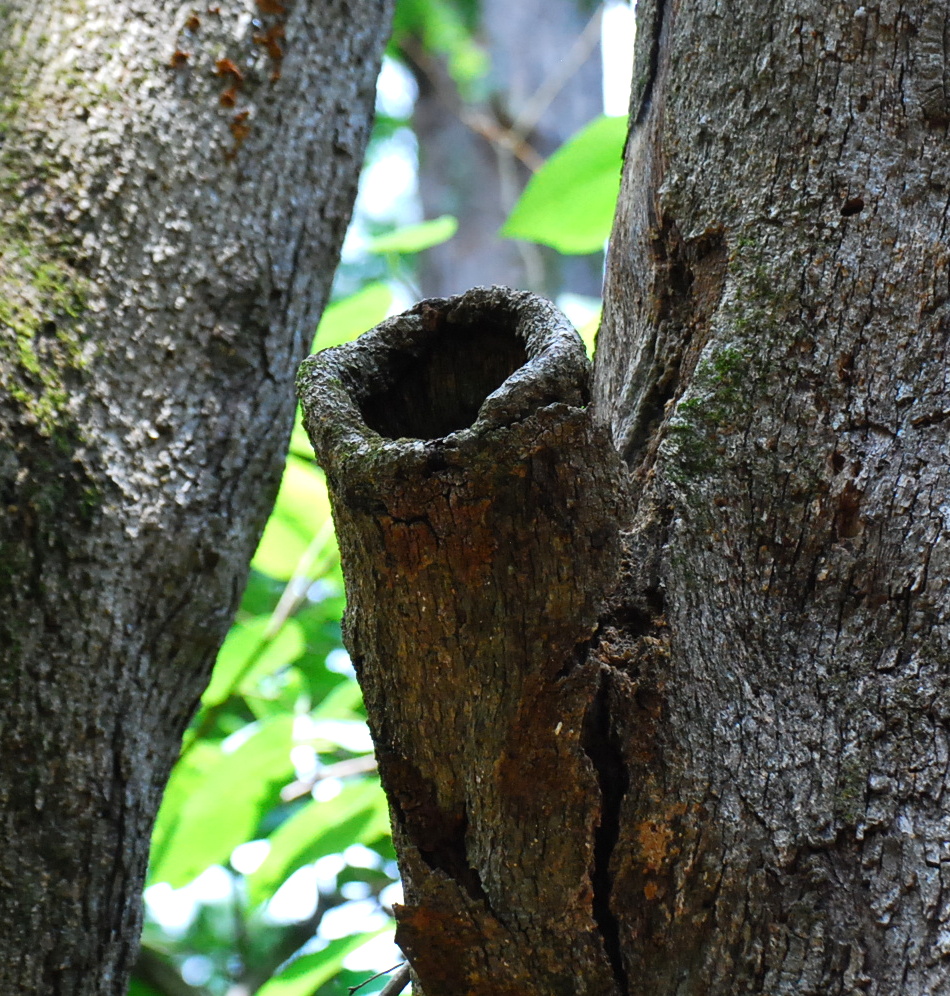
Tree cavity (Terry W. Johnson)
By Terry W. Johnson
One of the things I like most about living in Georgia is that during most winters we do not have to deal with many days of extremely cold weather. However, when temperatures do plummet well below 32 degrees Fahrenheit, we can find refuge in our cozy well-insulated homes.
But that luxury is not available to local wildlife. Extremely cold temperatures are particularly threatening to birds that roost in cavities. For birds, the ability to find suitable roost sites where they can escape frigid winds and temperatures can determine whether or not they make it through the winter. In many areas, however, roosting cavities range from scarce to next to impossible to find.
There are many reasons why the availability of natural roosting cavities falls far short of the demand. Each year across our state untold cavities disappear as thousands of acres of woodlands are transformed into croplands, shopping areas, highways and housing developments. In addition, before winter arrives competition for the available cavities is keen. Most are claimed by birds that bred locally, well before their young and migrant birds that winter here have a chance to compete for them. In addition, birds often have to share cavities with other animals, such flying squirrels.
Remember the fairy tale about Goldilocks and the three bears? When Goldilocks visited the bear’s cabin she found that when she tasted the porridge, try to sit in the chairs and laid in the beds of all the bears, the only porridge that was not too hot, chair that was not too hard (though she broke it!) and bed that was just right belonged to the baby bear. Such is the case with cavities. Often cavities are too deep, too high in a tree, have entrance holes that are too small or contain too much leaf and grass litter to suit individual bird species.
For all practical purposes, the only birds capable of excavating their own cavities are woodpeckers and the brown-headed nuthatch. Each of these, with the exception of the red-cockaded woodpecker (it excavates its cavities in live pine trees), chisel out cavities in dead trees and limbs. They use these cavities for both nesting and roosting. Woodpeckers – such as the pileated, downy and hairy – hollow out separate cavities used for both nesting and roosting. In the case of the pileated, a pair uses one nest and several roost cavities per year. Interestingly, a pileated woodpecker occupies a nest cavity only once and then abandons it.
The list of local birds that use cavities as winter roost sites include the eastern bluebird, Carolina chickadee, tufted titmouse, Carolina, house, and winter wrens, and woodpeckers (downy, hairy, pileated, red-bellied, red headed and red-cockaded). Why, even blue jays have been known to seek shelter from the cold in cavities.
As for downy woodpeckers, during fall the cavities they excavate to serve as roost sites typically face away from the prevailing wind. Meanwhile, those dug at other times of the year are randomly oriented. It is believed this is because in winter, the interiors of cavities that face in the direction of prevailing winds get colder than those facing away from frigid winds.
A bird that roosts in a cavity during winter has a better chance of survival than when it is forced to spend a bitterly cold night elsewhere. It behooves a bird to use the same cavity night after night. If it is has to try and find a roosting cavity as the winter sun is setting, or unsuccessfully defends its roosting site from others, it is forced to expend valuable energy needed to survive the night.
Cavities are valuable because they insulate birds from the cold and wind. The overnight temperature inside a cavity can be 18 or more degrees warmer than the ambient temperature outside. Much of this heat is generated by the warm air exhaled by the birds. In addition, the chilling effect of the wind is also dramatically reduced. These factors enable birds roosting in natural cavities to expend less energy to stay alive. These savings can be dramatic. It has been calculated that they can enable a roosting bird to go an additional 5.7 to 7.3 hours without eating. For many birds, these precious few hours enable them to live to see the dawn.
Cavity-roosting birds exhibit some interesting habits. Carolina chickadees will roost in groups of two to eight. Northern flickers often roost in pairs. A dozen or more bluebirds will often roost together. Remarkably, although the winter wren does not nest in cavities, it roosts in them. Believe it or not, 46 winter wrens were spotted entering the same winter roosting cavity.
If you have dead trees standing on your land that do not pose a threat to people or property, leave them standing. In addition, if you do not have any natural roosting sites on your land, considering adding one or more roosting and nesting boxes. These cavities can help alleviate the roosting shortage in winter.
Although winter roosting cavities are often overlooked, they are a critical habitat component for many of our birds. Without them, many simply cannot survive the rigors of winter. When we lose these, the fabric of life for those of us who enjoy nature is tattered, leaving us poorer for it.
Terry W. Johnson is a retired Georgia DNR program manager and executive director of The Environmental Resources Network, or TERN, the friends group of DNR’s Wildlife Conservation Section. Check out past columns, his Backyard Wildlife Connection blog and his book “A Journey of Discovery: Monroe County Outdoors.” Permission is required to reprint a column.