An official website of the State of Georgia.

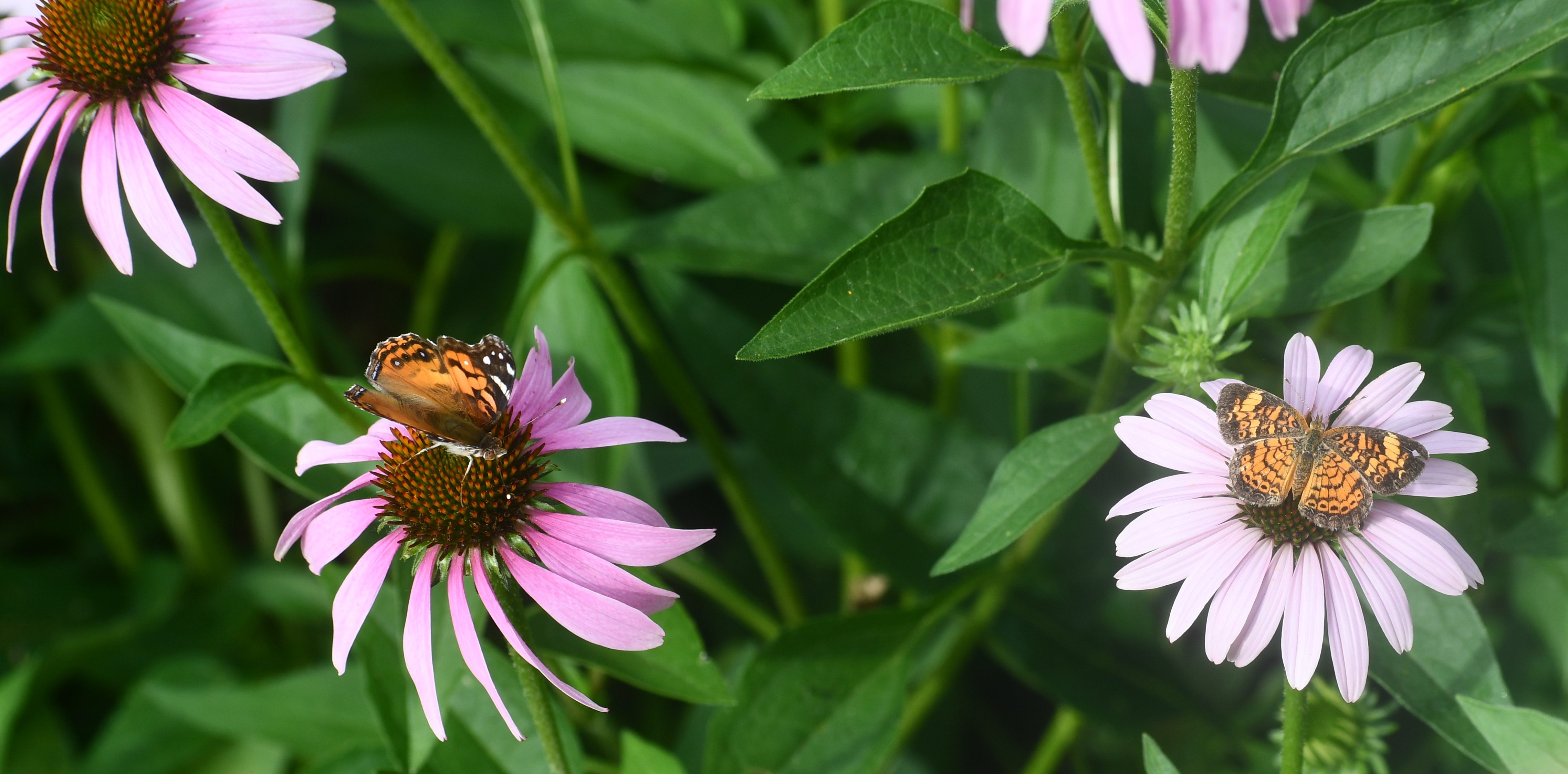
Cornflower with pearl crescent butterflies (Terry W. Johnson)
By Terry W. Johnson
Some will argue that purple coneflower (Echinacea purpurea) is our favorite native plant. Although I cannot attest to the validity of this claim, I can confirm that it is indeed a prized member of our backyard plant community.
There are many reasons why my wife and I are so fond of purple coneflower. It flourishes in spite of my lack of gardening acumen. Each year it produces a large crop of breathtaking blooms that seemingly last for weeks from May into September. Moreover, it does not require a lot of water and seems to prosper during hot weather.
We also appreciate the fact that white-tailed deer usually refrain for making a meal of the coneflower's foliage and flowers. And if we needed another reason to admire the plant, there’s this: It provides food for wide variety of wildlife.
Long before the first European explorers began penetrating the seemingly endless North American wilderness, Native Americans recognized the coneflower as a medicinal plant. They used it to cure a variety of ailments. It was also used to treat the bite of a snake called "mad dog." Nowadays, we call that snake a rattlesnake.
The reputed value of coneflower for treating rattlesnake wounds was shared with members of the Lewis and Clark expedition. According to their journals, when the party reached Fort Mandan in 1605 they collected and stored coneflower plants, labeling them as "mad dog plant."
Coneflowers are easy to grow. In our backyard, my wife and I have been successful in establishing stands of this perennial by planting seeds and transplanting plants from one place to another.
Whereas coneflowers are indeed native to North America, most species are native to the prairie states, also known as the Great Plains region. The popularity of this beautiful native has prompted plant breeders to develop scores of hybrid varieties that vary in size and flower color. In fact, each year since 2003, about five or more hybrid varieties of the plant have been introduced. Consequently, you can buy everything from double-flowered hybrids to dwarf varieties.
Nowadays the blossoms of coneflower cultivars range from purple to white, pink, yellow and green. This dizzying array of plants bears fanciful names such as secret affair, avalanche, coconut lime, cotton candy, fatal attraction, lilliput, meringue and even milkshake.
I must admit I know nothing about the wildlife values of any of these new creations. We have always stuck with the native purple coneflower. This plant grows upwards of 3 feet tall. As its name suggests, it produces long purple petals that surround a burnt orange conical disk. As time goes by, the petals droop, leaving the disk poking well above the petals. This gives each blossom a profile shared by no other flower in our garden.
The flowers attract a number of butterflies such as skippers, monarchs and swallowtails. In our yard, however, the most abundant butterfly visitors are common buckeyes. This is fine because, in spite of its lackluster name, the common buckeye is uncommonly beautiful.
The biggest problem the butterflies have trying to nectar on our coneflowers is finding a space to feed. The reason for this is a host of native pollinators descend on the showy flowers. In fact, in our yard, bumblebees, leafcutter bees, sweat bees and some of the smallest bees (ones I have yet to identify) you can imagine are regular visitors to the blossoms.
Bumblebees are particularly fond of coneflowers. It is not uncommon to see three to six or more bumblebees feeding on a single blossom.
After the petals eventually fall to the ground, the plant’s value to other wildlife is just beginning. This is because many songbirds relish the prickly seeds. The American goldfinch's fondness for coneflower seeds is well known. Other birds such as sparrows, eastern towhees, nuthatches, Carolina chickadees, tufted titmice and northern cardinals also savor coneflower seeds.
As you might expect, since the plant has so many wildlife admirers, in order to provide these fans with an abundance of food, coneflowers should be established in mass planting. Such groupings are also visually more appealing.
It is not often you can find a plant that is attractive, easy to grow, beautiful and a valuable wildlife food source. But coneflower is such a plant. Consequently, it deserves a place in your garden.
Terry W. Johnson is a retired Georgia DNR program manager and wildlife biologists. Check out past columns, his Backyard Wildlife Connection blog and his book “A Journey of Discovery: Monroe County Outdoors.” Permission is required to reprint a column.