An official website of the State of Georgia.

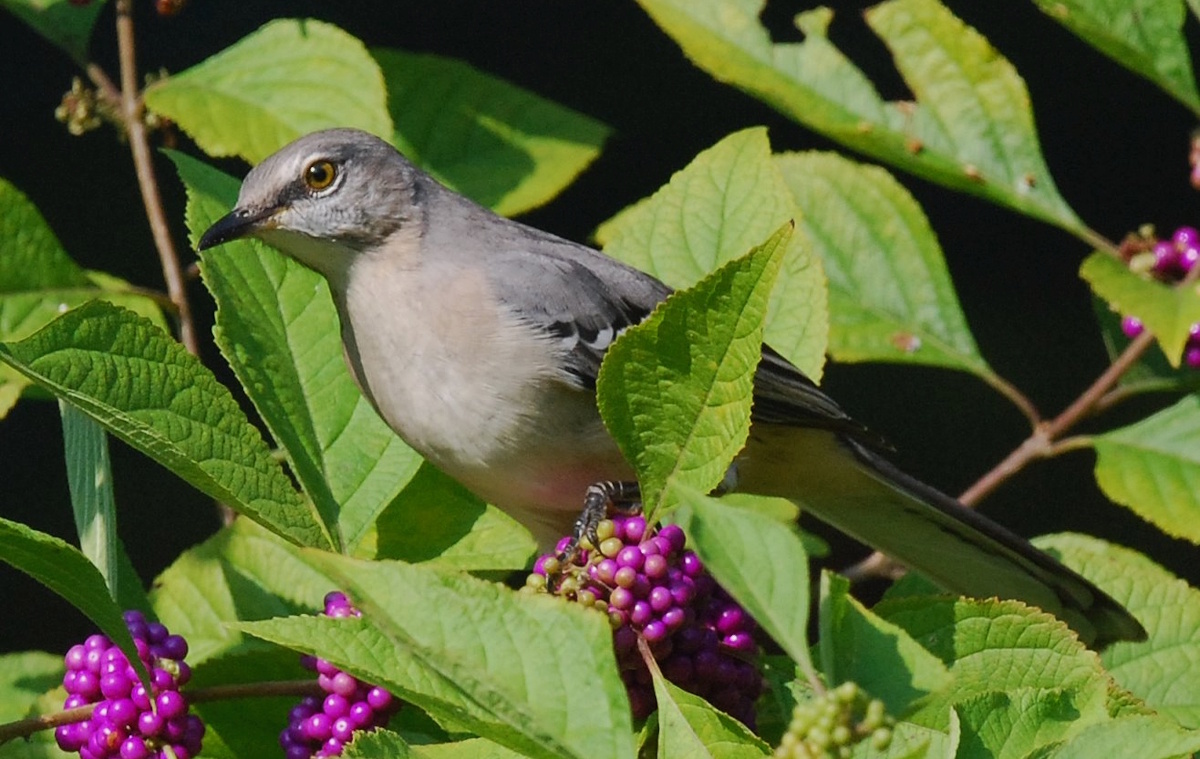
Northern mockingbird feed on American beautyberry (Terry W. Johnson)
By Terry W. Johnson
If you are like me, you are an avid fan of legendary sleuths such as Sherlock Holmes, Hercule Poirot and Jessica Fletcher. When we read about or watch the exploits of these detectives at work, it is impossible not to try to solve the mystery before they do. But if you are looking for new mysteries, remarkably, many can be found in your own backyard.
One example is why do mockingbirds leave their spring and summer homes? Currently, many Georgians will admit they want to know why mockingbirds that inhabit our yards in the year’s warmer months simply vanish at the end of summer. Although the disappearance it is not as engrossing as a jewel theft or murder, it is important to Georgians who enjoy seeing and listening to these popular birds.
The popularity of this gray and black bird is unquestioned. It is the state bird of two of neighboring states – Tennessee and Florida – plus Texas, Arkansas and Mississippi. If fact, only two other birds, the cardinal and western meadowlark, have the distinction of being the state bird in more states. Our affection for the mockingbird can be traced to the 18th Century, when northern mockingbirds were sold as caged birds. President Thomas Jefferson kept a pet mockingbird named Dick in the White House.
The infatuation is not surprising. Mockingbirds commonly nest and raise their young close to our homes. The birds are also accomplished songsters, and sing day and night. In addition to the bird’s own complex melodic song, mockingbirds can imitate the songs and sounds made by more than 200 other animals, including numerous mammals, frogs, toads and insects. They also vocalize the sounds of car alarms and dinner bells. A mockingbird that once lived in my backyard would mimic the ringtone of my flip phone.
Since we see and hear mockingbirds so often it is easy to take them for granted until suddenly one day we realize they are gone. Mockingbirds most often abandon our yards in the fall. This happens even though we provide them with water, suet, jelly, cornbread and other treats, as well as places to nest and roost. The birds seem to have everything they need, yet often one or more simply vanishes.
Over the years a number of biological sleuths have tried to solve this mystery. Fortunately for us, it appears they did. Their research suggests that the answer is a lack of winter food.
Throughout most of the year, up to 75 percent of a mockingbird’s diet consists of insects and other small critters. (When mockingbirds are feeding young, a single bird can eat 720 insects a day!) During spring, summer and fall, most of our yards are teeming with insects. Mockingbirds also supplement their diet with a variety fruits and berries.
But once cold weather sets in, the insect population crashes. When this happens, mockingbirds can change eating more fruits and berries. These foods comprise 65 percent of their winter diet.
Consequently, if your yard does not have an abundance and variety of plants that produce fruits and berries that persist well into the winter, chances are mockingbirds will often leave for a winter feeding territory rich in these critical food sources.
Also, typically during summer a male and female will share a territory. In winter, however, feeding territories may be used by a pair of the birds or a lone male or female. In my case, one only of the two mockingbirds that inhabited my yard last year is still here in winter.
Therefore, when you walk about your yard looking for clues to explain why the birds vanished, focus on whether or not your landscape includes a number of fruit- and berry-producing plants that retain their bounty during the winter. If not, you have undoubtedly solved the mystery of the missing mockingbirds. In spite of your feeder offerings, the birds cannot find enough food to weather the harsh winter in your yard.
If you want to host a mockingbird or two during winter, you need to establish plants that offer mockingbirds the food they need at that time of year. This ensures that should one of these plants fail to produce a crop of berries or fruit, the birds will be able to find food on other trees or shrubs.
Here’s partial list of plants that grow in Georgia that play a major role in the mockingbird’s winter diet: American holly, smooth sumac, hawthorn, Carolina snail seed, flowering dogwood, Virginia creeper, hackberry, American beautyberry, pokeweed, and Callaway crabapple.
I hope you find this information helpful. I have learned that when we enhance or knowledge of the plants and animals that live outside our backdoor, the more we appreciate them.
And the next time you walk outside and look around your yard, you will find that this special place is full of mysteries just waiting to be solved. Let the investigations begin!
Terry W. Johnson is a retired Georgia DNR program manager and executive director of The Environmental Resources Network, or TERN, the friends group of DNR’s Wildlife Conservation Section. Check out past columns, his Backyard Wildlife Connection blog and his book “A Journey of Discovery: Monroe County Outdoors.” Permission is required to reprint a column.