Summary of Primary Quail Management Recommendations
-
Prior to implementing management
practices: determine specific harvest and
habitat management objectives.
-
Use combinations of winter disking,
planting, burning or herbicides to establish and maintain
fallow fields, field borders, hedgerows, field corners, ditch
banks, wetland borders, forest openings, widened roadsides,
thinned pine stands and other habitats in a mixture of erect
weeds, cultivated plantings, clumped native grasses and
briars.
-
Convert portions of exotic grass
pastures and fields to native warm season grasses
and implement rotational haying or grazing.
-
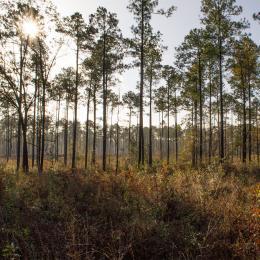
Within its original range, favor
longleaf pine over other pine species.
-
Use wide seedling spacing, such as 8
feet by 10 feet or 8 feet by 12 feet when regenerating pine
stands.
-
Thin pine stands regularly to
maintain 40-60 percent of the ground in direct sunlight.
-
Prescribe burn so that 50-70 percent
of the area is burned yearly.
-
Manage forest stands on long
rotations.
-
Establish 15-40 percent of forest
stands in openings that are 2-5 acres in size.
-
Maintain openings as fallow fields
with combinations of winter disking, planting, burning and
herbicides.
-
Do not disk, mow or otherwise
disturb field borders, openings or other fallow
habitats during the April through October nesting and brood
rearing season.
More quail can be produced through
management, but the old saying, "you can''t get something for
nothing" is all too true. Effort and money are
required. The amount required is based on the habitat
development needed and the density of quail desired. Where maximum
quail production is the objective both direct costs and opportunity
costs can be great. However, huntable populations can be
sustained at reasonable costs to the landowner provided that there
is enough appropriately located land with suitable soils and
vegetative cover.