An official website of the State of Georgia.


By Terry W. Johnson
If you were asked to name four plants that are associated with Christmas, what would you say?
You could not go wrong if you listed the holly, poinsettia, mistletoe and the Christmas tree. All of these plants will always be inexorably linked to this special holiday. However, in the hearts and minds of most Americans, the plant that symbolizes Christmas more than any other is the Christmas tree.
Each year millions of Americans center their celebration of this special holiday around a tree. A number of different kinds are used as Christmas trees. According to the National Christmas Tree Association, the most popular Christmas trees are, in descending order of popularity, the Frazer fir, Douglas fir, balsam fir, Colorado blue spruce, Scotch pine, eastern red cedar, white spruce, eastern white pine, white fir and Virginia pine.
However, throughout much of the 20th century, the Christmas tree of choice for most Georgians was the eastern red cedar. Most of us refer to this evergreen tree as simply cedar. The tree is abundant, has a natural "Christmas tree" shape and fills a room with the pleasant aroma of cedar.
Nowadays, the popularity of the cedar has waned. Some folks are buying artificial numbers fabricated from aluminum or plastic. The majority of those that still use a natural tree are choosing firs, spruces, pines or other varieties over the cedar.
Fortunately for our backyard wildlife neighbors, however, eastern red cedars are showing up in home landscapes with increasing regularity. This is due in large part to the tree's attractive conical shape, resistance to disease and drought, and low maintenance.
It should not be overlooked that it is also so valuable to wildlife and deserves the title of “the wildlife Christmas tree.” Unfortunately, in spite of the fact that the eastern red cedar provides wildlife with food, nesting sites and protection from the elements and predators, its importance to wildlife is rarely appreciated.
This native cedar can be found growing throughout most of the eastern U.S. It ranges across 37 states from as far north as New England south to Georgia and west to Texas. It is a common tree throughout most of Georgia, with the exception of our coastal counties.
This is the cedar commonly found growing around abandoned house sites, near vintage homes, in old cemeteries and along fence lines.
The eastern red cedar is an extremely adaptable plant. It can be found with its roots sunk into the damp flood plains that hug our rivers all the way to dry, red clay hilltops. About the only place it does not do well is under a heavy forest canopy.
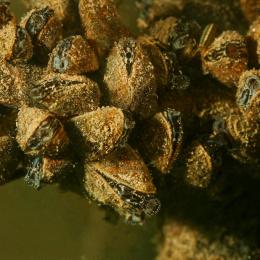
More often than not, the cedars that we see growing in fence rows have been unknowingly planted by birds. Cedar seeds are very hard and often pass unscathed through a bird's digestive system. When a bird perches on a fence and leaves behind a dropping containing cedar seeds, the hard seeds often germinate and eventually become a young tree.
Eastern red cedar trees are ideally suited for most yards. These long-lived (300-plus years), slow-growing evergreen trees can reach a height of 60 feet or more and measure 2 feet in diameter.
Here in the Peach State, eastern red cedars bloom in February and March. The berry-like cones are about a quarter-inch in size, , fleshy and colored greenish to blue. They mature from October to December. Each cone usually contains two hard seeds. The cones often persist until the following March. This is extremely important as they provide food for wildlife throughout the winter when food is often hard to come by.
Another great thing about red cedars is that they can be relied upon to fruit annually. Bumper crops are produced every second or third year.
Hosts of animals eat eastern red cedar foliage and fruits. For example, rabbits and deer will consume the foliage. More than two dozen birds dine on eastern red cedar fruits. This impressive list includes such backyard favorites as the American robin, northern mockingbird, brown thrasher, mourning dove, eastern bluebird and cedar waxwing. As you might expect, cedar waxwings are extremely fond of this winter food. The cones are also eaten by wild turkeys and quail. Coyotes, opossums, chipmunks and even armadillos consume them.
The trees are also the host plant for the beautiful, petite juniper hairstreak butterfly. This often-elusive butterfly spends its entire life in close proximity to cedar trees. Females lay their eggs on the cedars. Upon hatching, the caterpillars eat cedar foliage.
Even the adults are invariably found on the trees. Often the only way you can hope to see a juniper hairstreak is to tap on the trunk of a cedar tree. If the butterflies are present, they will briefly fly upwards before settling back into the thick, green foliage again.
A number of birds build their nests in cedar trees, including northern cardinals, brown thrashers, northern mockingbirds, American robins and common grackles. The dense foliage is ideally suited for escape cover. Birds will often fly into cedars to escape pursuing hawks. Also, cedar trees provide protection against rain, snow and sleet. In fact, during the winter, the interior of a cedar tree provides an ideal roosting spot on cold, blustery winter nights. At least 21 species of birds use the trees as roosting sites.
Some of the birds known to roost in cedars are chipping sparrows, northern cardinals, wild turkeys and eastern screech owls. I strongly suspect that wintering hummingbirds such as the rufous hummingbird also roost in these trees since I often find they are the only good roosting sites available in yards frequented by these western migrants.
It appears that the eastern red cedar may never again be the most popular Christmas tree in Georgia. However, the fact that it is prospering throughout the state and is even being becoming an integral part of backyard landscapes insures that this tree will remain an important wildlife plant well into the future.
On Christmas eve, when I look at my Christmas tree surrounded by lovingly wrapped presents, I will find it comforting to know that not too far from my backdoor stands my large wildlife Christmas tree. Although no colored lights hang from its spreading boughs, on the ground beneath it there will be untold numbers of tiny, blue nutrient-rich presents ready to be discovered on Christmas day by my hungry wildlife neighbors.
And when I pull up the covers and drift off into sleep I will know that the birds roosting in the tree are protected from the harshest winter weather.
If you are planning to build a home on a site where one or more eastern red cedars are growing, leave them standing. On the other hand, if there are no cedars in your yard, plant one or more. In either case, you will be giving your wildlife neighbors gifts that never stop giving –the dependable source of food, nesting sites and cover all packaged in the wildlife Christmas tree.
Terry W. Johnson is a former Nongame program manager with the Wildlife Resources Division, a backyard wildlife expert, and executive director of TERN, the friends group of the Nongame Conservation Section. (Permission is required to reprint this column. Contact rick.lavender@dnr.ga.gov.) Learn more about TERN, The Environmental Resources Network, at http://tern.homestead.com. “Out My Backdoor” archive.